
Money in Gdansk: Currency Exchange, Cards, BLIK, and Tipping Without the Mistakes
What you pay with in Gdansk, where to exchange money safely, how BLIK works and how much to tip — a practical guide to paying your way around the city.
You’ve landed in Gdansk, and the first practical question is: what do you actually pay with here? The złoty, not the euro — plus cards, your phone, and an oddity called BLIK, which you’ll see at nearly every till but probably won’t use yourself. Below is the full picture: where you can pay cashless, when cash comes in handy, how to avoid losing out on the exchange rate at a currency office or ATM, and how much you should actually leave as a tip.
What you pay with in Gdansk — the złoty, not the euro
Poland’s official currency is the złoty (currency code PLN, symbol zł), and it’s what you’ll pay with practically everywhere — in shops, restaurants, on the bus, at a currency exchange office, and for your apartment. Euros, dollars, and pounds are not legal tender in Poland, so an ordinary shop, tram, or petrol station won’t accept them.
There are exceptions — the odd hotel, souvenir shop, or spot near the airport will sometimes accept euros in cash. Don’t count on a good rate, though: the seller converts the transaction at their own rate, usually noticeably worse than at a currency exchange office, and you’ll get your change in złoty regardless. It’s simpler and cheaper to just pay in PLN.
The official reference rate for the złoty is published daily by the National Bank of Poland (Narodowy Bank Polski) at nbp.pl — a good benchmark for judging whether a currency office’s offer is reasonable, though it’s not the rate you’ll actually get exchanging cash around town. Rates change daily, so you won’t find a specific figure here — check it yourself shortly before you travel.
This article deliberately doesn’t add up what a whole trip will cost — that’s covered separately in → What a Trip to Gdansk Costs — A Realistic Budget. Here, we’re focusing purely on the mechanics of paying, and if this is your first visit to the city, → First Time in Gdansk — What You Should Know is also worth a read.
Card, phone, BLIK — where to pay cashless (and where cash still helps)
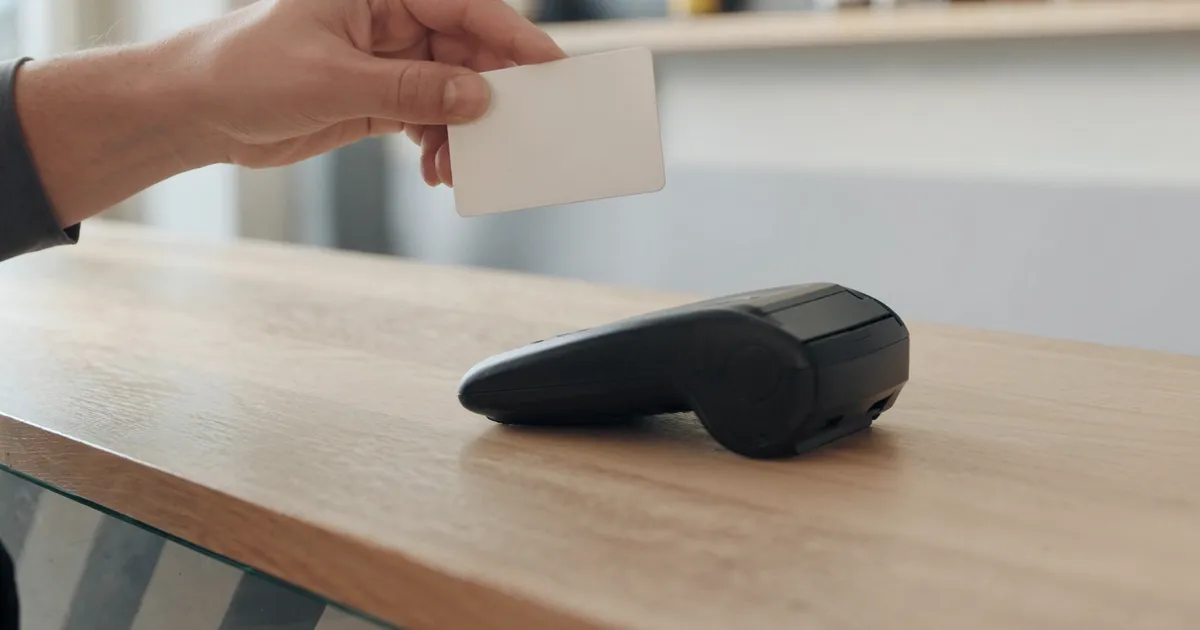
Poland is a heavily cashless country — contactless cards and phone payments (Apple Pay, Google Pay) work in practically every shop, restaurant, and museum, and at most parking meters in the city (more on the zones and rates themselves in → Parking in Gdansk). Visa and Mastercard are accepted almost everywhere; American Express less often — mainly at large hotels and chains.
At the till, you’ll also see BLIK — a Polish mobile payment system where, instead of a card, you type in a one-time six-digit code from a banking app. It’s everywhere, since almost every Pole uses it, but it requires a Polish bank account — as a tourist, you generally won’t be able to use it, unless you happen to hold an account with a Polish bank. Don’t worry about it: your card and phone will do exactly the same job.
Cash still makes sense in a few places: at markets and stalls (Hala Targowa, for instance), small kiosks, public toilets, and for tips. A separate case is taxis hailed off the street rather than booked through an app — if a driver suddenly claims, at the end of the ride, that the terminal isn’t working and demands cash only, treat that as a warning sign. Booking your ride through an app (Uber, Bolt, FREENOW) avoids this problem entirely, since the payment is settled in the app before you even get out.
| Payment method | Where it works in Gdansk | What to watch for |
|---|---|---|
| Contactless card (Visa/Mastercard) | Shops, restaurants, museums, app-booked taxis, parking meters | If the terminal offers to convert to your own currency, decline (see the DCC section) |
| Phone/watch (Apple Pay, Google Pay) | Anywhere a contactless card works | Needs a charged phone and a connection to your bank — keep a card as backup |
| BLIK | Tills, online shops, ATMs — but only with a Polish account | Tourists without a Polish bank account generally can’t use it |
| Cash (złoty) | Markets, small purchases, tips, some seasonal fish-fry stalls | Only a few places take euros or dollars, and at a worse rate |
| ATM withdrawal | Bank ATMs across the city | Check your bank’s foreign withdrawal fee, and always choose to be charged in PLN |
What a kantor is, and how it differs from a bank
A kantor is a private currency exchange office — not a bank or a bank branch, but a separate business, often a small shop with a rate board in the window. You walk in, state the currency and amount, and get złoty in cash (or the other way round), with no account to open and no appointment needed — usually within a few minutes.
A kantor makes its money on the spread between the buy and sell rate, not on a separate commission — most Polish exchange offices don’t charge an extra fee for the transaction itself. This can be misleading: a “0% commission” sign in the window doesn’t mean the exchange is free, only that the entire margin is already baked into the gap between the rate at which they buy your currency and the rate at which they sell it back to you. The narrower that gap, the better the deal.
Banks also exchange currency over the counter, but usually on worse terms than a dedicated kantor — shorter opening hours, sometimes a requirement to hold an account, and rates geared more toward corporate clients than tourists. For a one-off cash exchange, a kantor in the city almost always beats a bank.
Kantor, ATM, or card — what works out cheaper
In practice, you have three ways to get złoty in your pocket or onto your account:
- Pay directly by card or phone — your bank converts the transaction at its own rate, sometimes adding a foreign payment fee on top. Some modern accounts (neobanks, multi-currency accounts) don’t charge this fee at all — check your card’s terms before you travel, since they vary from bank to bank.
- Withdraw cash from an ATM — the same mechanism as with a card applies, plus sometimes a separate withdrawal fee from the ATM itself, independent of your own bank. There’s also the risk of the DCC trap, described below.
- Exchange cash at a kantor — you pay no card or ATM fees at all, just the kantor’s spread, but you’re left carrying cash around.
There’s no single universal answer — what pays off depends on your own card’s terms, and the only way to check that is your bank’s own terms and conditions. A sensible approach: use your card or phone for everyday spending if your bank doesn’t charge extra for it, and keep a small amount of cash from a kantor on you for tips and emergencies.
The currency-conversion trap (DCC)
At a card terminal or an ATM, you’ll sometimes see a prompt along the lines of: “Pay in PLN or in [your currency]?” or “Would you like a guaranteed rate in EUR/USD?” This is a mechanism called Dynamic Currency Conversion (DCC), and it’s almost always worth declining.
Here’s how it works: if you agree to convert straight into your own currency, the exchange rate isn’t set by your bank or the card network (Visa/Mastercard), but by the merchant’s payment system or the ATM operator — and that rate routinely includes an extra margin stacked on top of an already worse conversion. As a result, you end up paying more than if you’d been charged directly in złoty, sometimes twice over: first the DCC margin, and then your own bank’s foreign transaction fee on top, if your card charges one.
The rule is simple: always choose to pay in PLN, never the “in your currency” or “guaranteed rate” option. Your own bank will convert the amount at the end anyway, usually at a better rate than a terminal or ATM abroad. This applies both to card payments in shops and to cash withdrawals from ATMs — the currency prompt can show up in either place.
Tipping in Poland — how much, for whom, and whether it’s expected
Tipping in Poland is optional — nobody formally obligates you to leave one, and a restaurant bill usually doesn’t include an automatic service charge. The exception tends to be large groups — some restaurants then add a separate service line directly on the bill, so before you leave anything extra, check whether that charge is already there. For more on where — and for what — it’s worth paying on the spot, see → Where to Eat in Gdansk — A Food Guide.
In a restaurant with table service, the accepted norm is 10–15% of the bill. In a café, bar, or over a regular espresso, rounding up is enough — nobody expects a percentage calculation there. It’s customary to round up the fare for a taxi driver too, though that’s not obligatory either.
A practical note on paying by card: Polish terminals usually don’t have a screen prompting you for a tip, unlike what you might be used to in, say, the United States. If you want to leave a tip by card, tell your server before they run the payment — they’ll add it to the amount by hand, or ask for a separate transaction. The simplest approach is to leave the tip in cash next to the bill, whatever you use to pay for the rest.
Where to exchange money in Gdansk, and what to watch out for
You’ll find the most currency exchange offices in Gdansk in the Old Town and Główne Miasto — along Długi Targ, Długa Street, and the side streets of the Old Town. That’s convenient, since they’re everywhere, but it also means it’s worth comparing a few offers before settling on the first one you see.
Exchange rates hang on a board in the window, so comparing costs nothing — walk a little further and check a few boards instead of walking into the first shop on the main drag. A general pattern, familiar from most Polish tourist cities: kantory sitting right on the busiest stretch of a pedestrian street more often have a wider gap between the buy and sell rate than the ones a few blocks over, or inside large shopping centres. It’s not a rule without exceptions, but it’s reason enough not to exchange a large sum at the very first place you see.
A separate note on Gdańsk Lech Wałęsa Airport (GDN) — the exchange counters at the airport consistently come out worse than kantory in the city. If you’re landing and need cash right away, only exchange enough there to cover getting into the centre, and sort out the rest once you’re settled in.
If you’re staying in the Old Town, kantory are literally within arm’s reach — the → Bastion Wałowa apartments sit right in the middle of that area, so exchanging money takes a few minutes along the way, not a special trip.
Paying for your stay — currency, prepayment, invoice
When you book directly on mintapartments.pl, you pay in złoty — the price you see is the final amount in PLN, with no guessing at conversion rates and no DCC risk when you finalise your booking. You’ll see the exact payment terms in your booking summary before you confirm it.
If your plans change, a clear refund policy applies: free cancellation up to 7 days before arrival (100% refund), 50% refund for cancellations 3–7 days before arrival, and no refund for cancellations under 3 days before arrival. It’s worth checking this before you book, so you know where you stand if something suddenly comes up.
On request, we issue a VAT invoice — useful if you’re expensing the stay for business, or simply prefer a full document over a plain booking confirmation. If you’d like to ask something before booking, our team responds at rezerwacje@mintapartments.pl and on WhatsApp (+48 797 412 679).
The biggest money mistake in Gdansk isn’t a bad rate at a kantor — it’s not having a plan: getting stuck without cash where a card won’t work, or agreeing to a foreign-currency conversion at a machine. Bring a card, a bit of złoty to start with, and the reflex to say no whenever DCC comes up, and the rest falls into place on its own. If you’re looking for somewhere to stay close to the Old Town and its kantory, take a look at → Mint apartments, or message us at rezerwacje@mintapartments.pl — we’ll help you find the location that fits your plans.
Frequently asked questions
- Can I pay by card everywhere in Gdansk, or do I need cash?
- You can pay by card or phone (Apple Pay, Google Pay) in the vast majority of places — shops, restaurants, museums, and app-booked taxis. Cash still comes in handy at markets and stalls, small kiosks, for tips, and as a backup in case a card terminal happens to be down. It's worth carrying a small amount of złoty on you, but you don't need to rely on it as your main way of paying.
- Can you pay in euros in Poland?
- Generally, no — the only legal tender in Poland is the złoty (PLN), and ordinary shops, restaurants, and public transport don't accept euros. A handful of tourist-oriented places, especially near the airport, will sometimes take euros in cash, but at their own exchange rate, and you'll get your change in złoty regardless. It's considerably simpler and cheaper to just pay in PLN from the start.
- How much should you tip in Poland, and is it mandatory?
- Tipping in Poland is optional, and it's usually not added to the bill automatically — the exception tends to be large groups, where a restaurant may add a separate service charge, so it's worth checking the bill. In a restaurant with table service, the accepted norm is 10–15% of the bill; in a café or bar, rounding up is enough. If you're paying by card, tell your server about the tip before they run the payment, since Polish card terminals usually don't have a separate screen for adding one.
- What works out cheaper — a currency exchange office, an ATM, or a card?
- It mostly depends on your own card's terms, so there's no single answer that holds for every bank. Paying by card or phone is the most convenient option, and sometimes free if your bank doesn't charge foreign transaction fees — check this before you travel. Withdrawing cash from an ATM sometimes adds the machine operator's own fee on top. A currency exchange office in the city (not at the airport) is usually the best way to get a larger amount of cash — compare a few rate boards before you exchange, and always decline the option to convert into your own currency, whether at the exchange office, a card terminal, or an ATM.
Help me book an apartment
The AI concierge matches an apartment to your plans — dates, party size, district. Replies in seconds.
Apartments that fit this stay
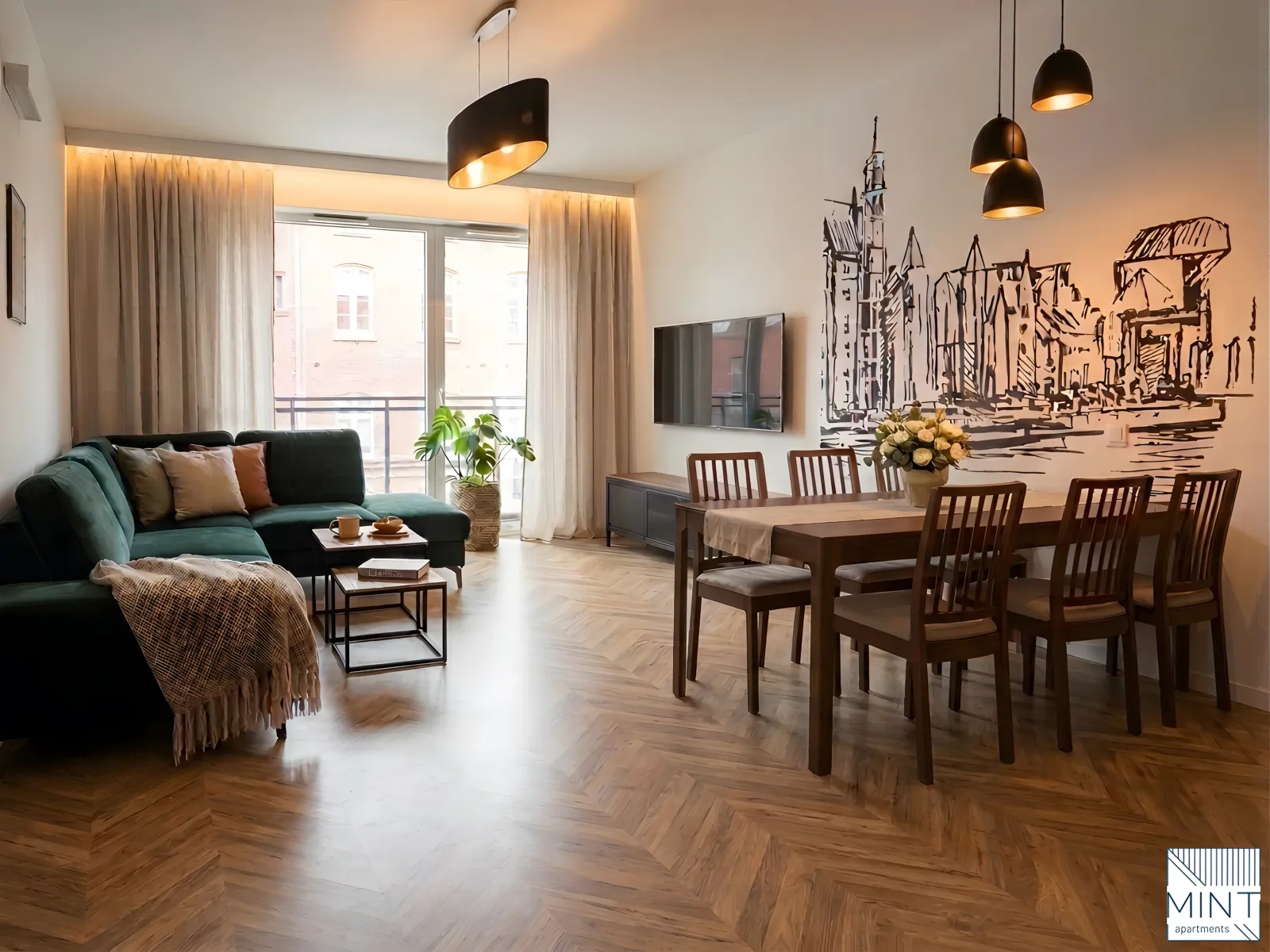
Apartament Bastion Wałowa z dwiema sypialniami
- 2 bedrooms
- 3 beds
- 6 guests
- 65 m²
A spacious two-bedroom apartment with two bathrooms and a balcony right in the heart of Gdańsk on Wałowa Street — 65 m² for up to 6 guests. Balcony overlooking Wałowa Street and the historic Śródmieście quarter. Długi Targ is 400 metres on foot. Fully equipped kitchen with coffee maker, Smart TV, fast Wi-Fi, washing machine and oven. Underground garage. The largest Mint apartment in the Bastion Wałowa location — the top pick for families and groups of friends.
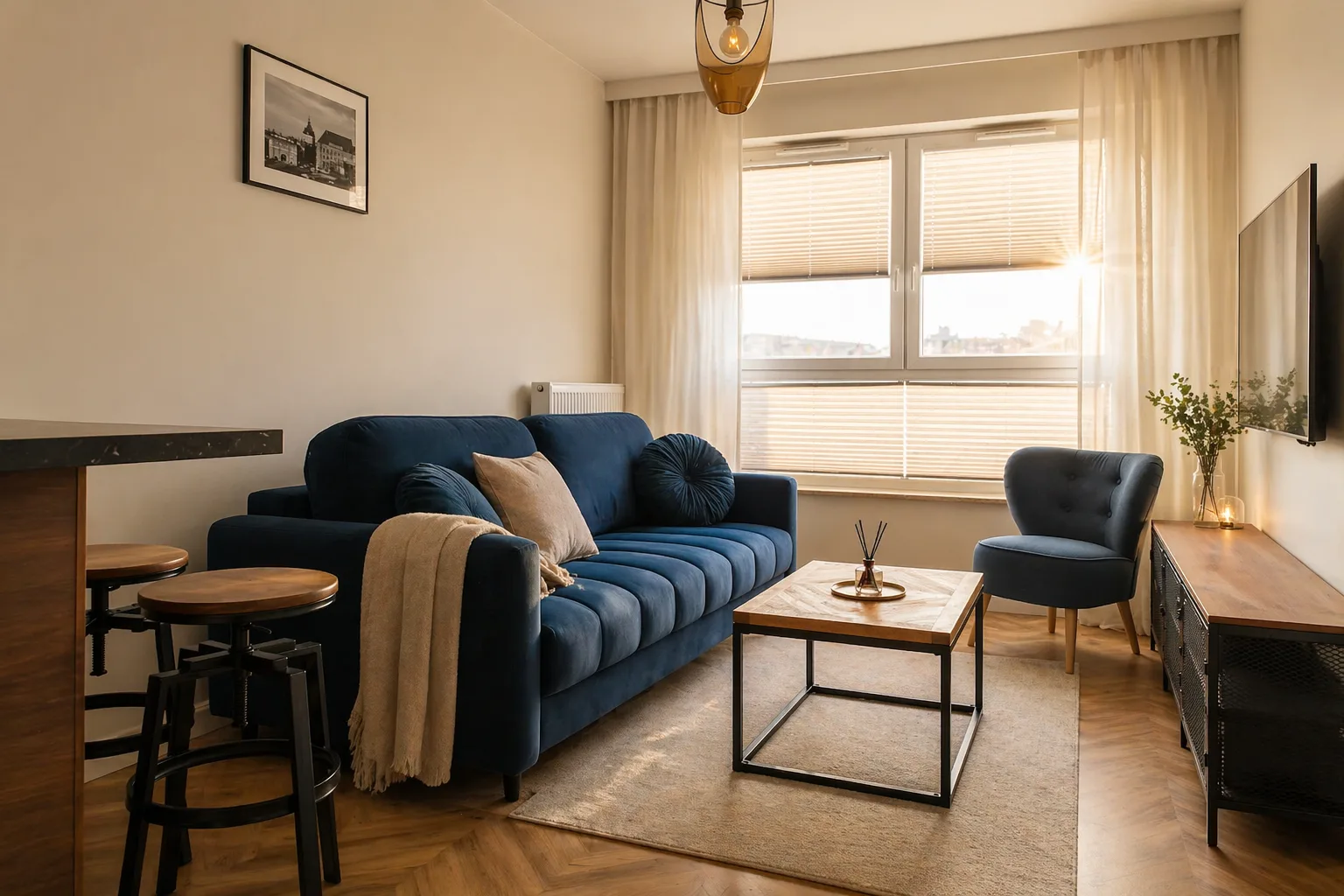
Apartament Suite Bastion Wałowa
- 1 bedroom
- 2 beds
- 4 guests
- 37 m²
A suite apartment right in the heart of Gdańsk on Wałowa Street — 37 m², bedroom with a king-size bed, fully equipped kitchen with coffee maker, fast Wi-Fi and Smart TV. 5 minutes' walk to the Old Town, 7 minutes to Długi Targ. Modern finish in the new wing of the Bastion Wałowa complex, lift and underground garage. Ideal for a couple or small family wanting quiet comfort in the historic centre of Gdańsk.
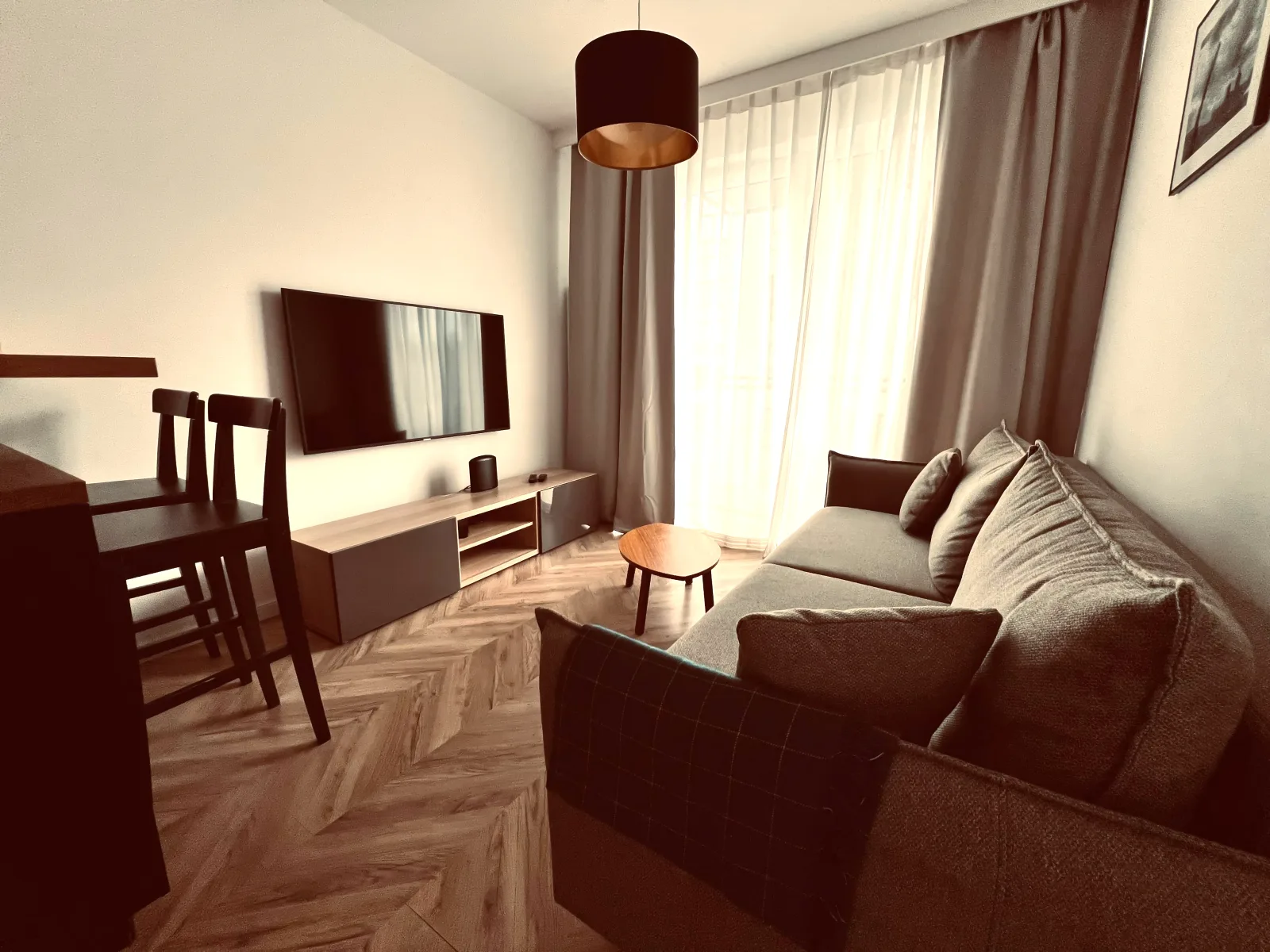
Apartament standard Bastion Wałowa
- 1 bedroom
- 2 beds
- 4 guests
- 36 m²
An apartment on Wałowa Street in the heart of Gdańsk — bedroom with a comfortable bed, fully equipped kitchen, shower bathroom. Underground garage, lift, fast Wi-Fi. No unnecessary extras — with an address that speaks for itself. Długi Targ 7 minutes on foot, Main Railway Station 350 metres, tram to Letnica and the beach 15 minutes. The best price-to-location ratio in the entire Bastion Wałowa complex.
Liked these topics?
Monthly guide to Gdańsk — events, new places, our apartments and their availability. No spam, just one email.
Related posts
Dolne Miasto in Gdansk — What to See Away from the Old Town Crowds
The bastions, Śluza Kamienna and the Opływ Motławy canal — minutes from Długi Targ, barely in guidebooks. What to see and where to start the walk.
Gdansk for People with Disabilities — A Barrier-Free Guide
Transport, the Old Town, beaches, and museums with lifts — a tested guide to accessibility in Gdansk for people with disabilities and reduced mobility.
The Free City of Danzig, 1920–1939 — What Traces You Can Still See Today
The Free City of Danzig disappeared from the map in 1939, but its traces still stand in the city. Here's exactly what you'll see, and how to turn it into a route.